
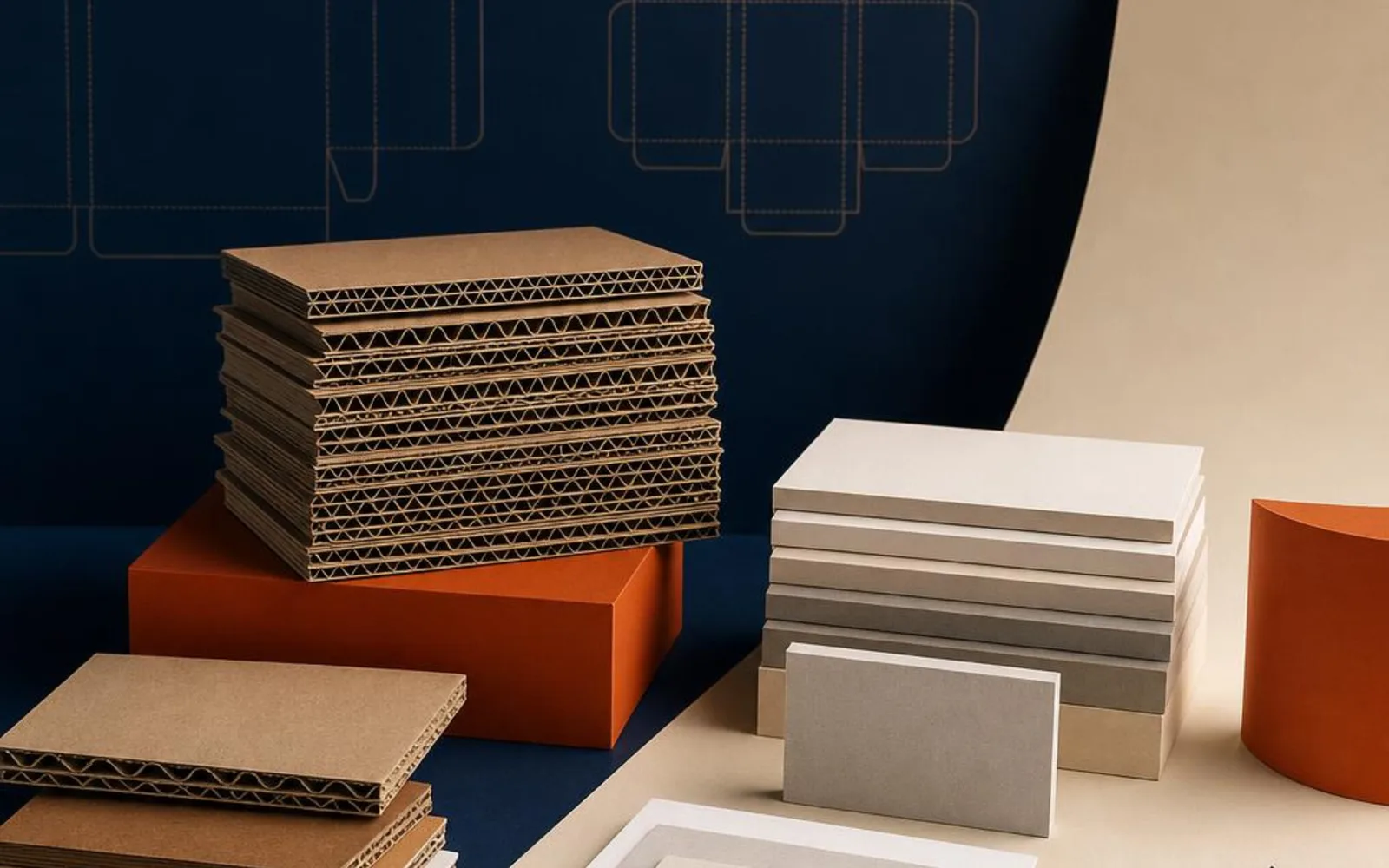
People use “cardboard” to mean almost any stiff paper box, which is fine in conversation and unhelpful when you’re ordering packaging. The word covers two quite different materials, and picking the wrong one shows up fast — either in a box that feels flimsy or one that’s overbuilt for what it holds.
So let’s sort out what’s what, without the jargon.
Cardboard is the everyday word
In loose talk, cardboard means any thick paper-based board. Cereal boxes, shoeboxes, the back of a notepad — all “cardboard” to most of us.
In the trade, though, the useful split is between folding carton board, which is a single solid ply, and corrugated board, which is a layered structure. Both start as paper. What changes is how they’re built, and that changes everything about how they behave.
Corrugated is the fluted sandwich
Corrugated board is a sandwich. Two flat outer sheets — the liners — with a wavy layer glued between them. That wavy middle is the flute, and it’s the whole point.
The ripples act like tiny arches. They hold the two liners apart, resist crushing, and add cushioning, all while keeping the board fairly light for its strength. It’s the same principle that makes a folded sheet of paper stand up when a flat one flops. This is the board behind most shipping and cardboard boxes and the sturdier mailer boxes.
The flute gives strength without weight
Because the strength comes from the shape rather than sheer thickness of solid material, corrugated punches above its weight. You get stacking strength and a shock-absorbing wall without a heavy, dense board.
That’s why it dominates anything that travels. A carton needs to survive being stacked, dropped and shuffled through a courier network, and the flute is what lets it take those knocks and spring back.
You can prove the principle at your own desk. A flat sheet of paper flops the moment you hold it out horizontally. Fold that same sheet into a fan of ridges and it suddenly holds its shape and bears a little weight. Nothing was added — the material just gained a structure. Corrugated board is that trick made permanent, with liners glued on to keep the ridges in place.
Where folding carton board wins
Single-ply folding carton board is smooth, flat and thin. That makes it the better choice in a few clear cases.
- Crisp print. A flat, smooth surface holds fine detail and colour beautifully, with none of the faint ribbing a coarse flute can telegraph through the liner.
- Tight, clean folds. Thin board creases sharply, so intricate tuck-and-lock shapes come out neat rather than bulky.
- Lighter products. Cosmetics, confectionery, small retail items — things that need to look sharp on a shelf but aren’t going to stress the walls.
If your box mostly lives on a shelf or gets handed over a counter, folding carton often looks the part better.
Where corrugated wins
Corrugated takes over the moment weight, distance or stacking enters the picture.
- Postal journeys. Anything posted wants the cushioning and rigidity a flute provides.
- Weight. Heavier products need walls that won’t bow, and corrugated holds its shape under load.
- Stacking. If boxes will sit on top of each other in storage or transit, the flute is what stops the bottom one caving in.
Flutes in plain English
You’ll hear flutes described as fine or coarse, and the difference is simply the size of the ripples. There’s a broad rule of thumb worth knowing.
Finer flutes give a smoother, flatter surface, so they print better and fold more tidily — think retail-facing boxes. Coarser flutes have taller ripples with more air in them, so they cushion better and resist crushing — think protective shippers. Plenty of boxes sit in between, but that trade-off, print versus cushioning, is the one to hold in your head.
You don’t need to memorise the flute names to make a good choice. It’s enough to tell us whether the priority is a clean printed finish or maximum protection, and roughly how the box will be used. The flute follows from that. Trying to pick the flute before you’ve pinned down the job is doing the steps in the wrong order.
A quick note on eco instincts
Both materials are paper-based, which is part of why they appeal to brands thinking about their footprint. Corrugated board is widely recycled through ordinary household streams, and kraft variations are unbleached, which gives that honest brown look some brands prefer. Those are general truths rather than promises about any one box, but they’re a fair reason the family remains a sensible default for a lot of packaging.
Choose by the journey, not the name
The cleanest way to decide is to ignore the word “cardboard” entirely and follow the product’s journey instead.
Is it being posted, stacked, or carrying real weight? Lean corrugated. Is it light, shelf-bound, and relying on sharp print to sell itself? Lean folding carton. Food packaging often needs both instincts at once — a printable face and a bit of grease resistance — and our food boxes are built with that balance in mind; food-safe options are available, so tell us what you’re packing when you enquire.
Get the journey right and the board almost chooses itself.
The short version
Cardboard is the family name. Corrugated is the fluted, travel-hardened cousin; folding carton is the smooth, print-friendly one. Match the board to what the box has to survive and how it has to look, and you’ll rarely go wrong.
If you’d rather not guess, describe your product and its journey and we’ll point you to the right board.