
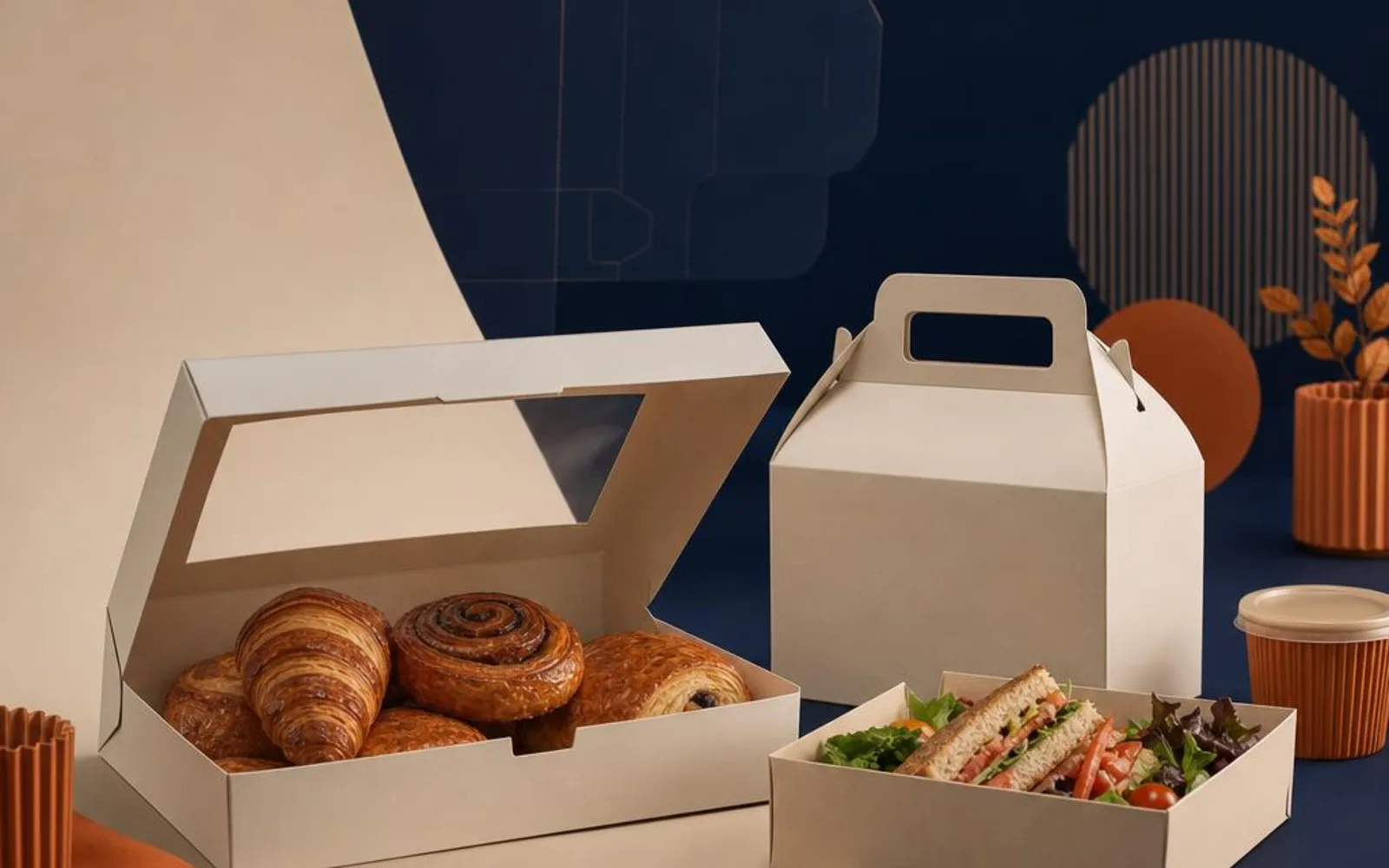
A food box has a harder job than most people give it credit for. It has to survive grease, steam and a slightly rushed member of staff, keep the food looking like it did on the counter, and — on the walk or drive home — act as a small advert for your café with your name on it.
Get it right and it does all that quietly. Get it wrong and the customer remembers a soggy base long after they’ve forgotten the sandwich.
The three jobs a food box does
Before you choose anything, it helps to be clear about what you’re asking the box to do. There are really three tasks.
- Protect. Keep the food intact — no crushed icing, no shifting contents.
- Carry. Be genuinely easy to hold, stack and hand over.
- Advertise. Carry your name out of the door and onto a kitchen table.
Most packaging problems come from a box that nails one of these and forgets the other two. You’re looking for the one that does all three well enough. Our food boxes are built with that balance in mind.
Grease and moisture: the quiet test
This is where food packaging is really judged. A pastry, a burger, a warm slice of cake — all of it puts grease and steam against the board, and plain board gives up quickly.
The board and any liner you choose decide whether the base holds firm or turns translucent by the time it’s home. Warm food also releases steam, and a box with nowhere for that steam to go leaves everything limp. There are food-safe options for direct contact with food — tell us what you’re packing when you enquire and we’ll match the board and liner to it rather than guessing.
It helps to be honest with yourself about the worst-case item on your menu. If most of what you sell is dry but one thing is warm and greasy, that one thing sets the spec, because customers won’t forgive a leak just because the other boxes held up. Packaging is judged by its weakest moment, not its average one.
Windows sell the impulse buy
People buy cakes and pastries with their eyes, and a closed box hides the very thing that makes the sale. A clear window turns the packaging into a display.
It works on the counter, where a stacked wall of boxes shows off what’s inside, and it works at home, where the box still looks like something worth opening. For bakeries especially, our window boxes earn their keep on impulse buys, while cupcake boxes hold delicate items steady so the icing arrives the way it left.
Stacking and carrying
Think about the human at the till and the human walking out. A box that stacks neatly behind the counter saves space and speeds up service; a box that carries well saves your reputation on the pavement.
Handles matter for larger orders and multi-box collections. Trays and inserts keep drinks and delicate items from sliding. And a flat, stable base is the unglamorous feature customers never mention but always notice when it’s missing.
Think, too, about the closure. A box that pops open in a carrier bag has failed at the one job the customer cared about, and a fiddly closure that holds up your queue at the till has failed at another. The best closures are quick for your staff to fasten and secure enough to trust on the journey home. That balance is easy to overlook until a busy Saturday exposes it.
Counter space and flat-pack storage
Behind the scenes, storage is a real constraint. A small café doesn’t have a warehouse, so boxes that arrive flat and fold up as needed are worth their weight.
Flat-pack packaging tucks into a cupboard and gets assembled on demand, which keeps your prep area clear and means you’re not tripping over pre-built boxes on a busy morning. When you’re weighing up styles, factor in how much room you actually have to keep stock.
Match the box to how the food travels
The last question is the one people skip: how does this food actually reach the customer? The answer changes the box.
Handed over the counter
Here presentation leads. The customer sees the box straight away, so a clean design, a window, or your name printed well does real work. The journey is short, so protection is a lighter concern.
Into a delivery bag
Now the box is stacked, jostled and possibly tipped in a courier’s bag. Structural strength, a secure closure and a steady base matter more than a window nobody will see until it arrives. Steam management becomes critical, because the food sits sealed up for longer.
Some businesses need both, which usually means two box styles rather than one compromise that half-suits each.
Putting it together
Start with the food and its journey, then work outwards: the right board for grease and steam, a shape that protects and stacks, a window if it sells, and your name printed where it’ll be seen. That’s a food box doing all three of its jobs.
If you tell us what you’re packing and how it reaches your customers, we’ll help you spec a box that holds up all the way home.